







DESCRIPTION
Texas Hold’em is a card activity enjoyed by many people around the world. The goal for each person at the table is to form the strongest combination of five cards using a mix of personal and shared cards, or to continue in the round while others decide to step back.
The activity uses a standard 52-card deck and takes place at a table that can seat up to ten people. A special marker (the button) indicates the coordinator and shows the order in which turns are taken.
The session begins with required contributions called blinds. The first person to the left of the button places a small contribution, and the next person places a larger one. Each person then receives two cards face down. The person to the left of the larger contribution acts first, and turns continue clockwise.
A round continues until all people either step back or have matched the contributions required to remain active.
After the first round, if at least two people remain active, the coordinator places three shared cards (called the flop) face up in the center of the table. Everyone may use these cards to form combinations. A new round of contributions follows, starting with the person to the left of the button.
Next, a fourth shared card (called the turn) is placed, followed by another round of contributions. Finally, the fifth shared card (called the river) is placed, followed by the last round of contributions.
When all rounds are complete, everyone reveals their two personal cards. The strongest combination of five cards—using any mix of personal and shared cards—is recognized as the top combination for that round.
Forming a Combination of Five Cards
Each person may create a combination of five cards in these ways:
-
Both personal cards plus three shared cards.
-
One personal card plus four shared cards.
-
Only the five shared cards.
Only the strongest combination of five cards is used to determine the outcome for the round.
Round Options
During each round, people may take one of the following actions:
Pass
If a person does not want to add a contribution at that moment, they may “pass,” allowing the turn to move to the next person while remaining active. If someone else adds a contribution, the person who passed must decide whether to match it or step back.
Match
When a contribution has been made, “match” means to provide the same amount to remain in the round.
Step Back
To leave the current round without matching the contribution, a person can “step back.”
Add
To provide a new contribution or increase the existing one, a person may “add.” In this activity, there may be no maximum limit for contributions.
High Card
If no other combination is formed, the highest card determines the outcome. Card ranking from highest to lowest is Ace, King, Queen, Jack, 10 … down to 2. If two combinations have the same highest card, the next highest card is compared, and so on.
Hand names
Royal Flush
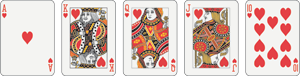
The highest ranking hand. It contains the cards 10-J-Q-K and Α of the same suit.
Straight Flush
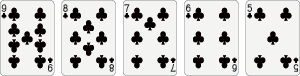
Five consecutive cards of the same suit.
Four-of-a-kind
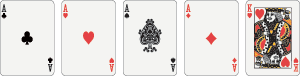
Four cards of the same rank and any other fifth card. Higher ranking cards defeat lower ranking cards, e.g. a four-of-a-kind with sixes is better than a four-of-a-kind with threes.
Full House
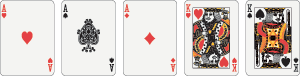
A combination of three matching cards of one rank and two matching cards of another rank. It is called Queens Full if the three matching cards are Queens, Nines Full if they are nines, etc. In any comparison, the hand with the higher-ranking three cards takes precedence.
Flush
A hand with five cards of the same suit. When comparing two flush hands, the hand with the highest-ranking card is ranked higher (the highest-ranking card is the Ace). If the highest-ranking card is the same for both hands, the second highest-ranking cards are compared, and so on.
Straight
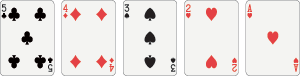
A hand that contains five cards of sequential rank in at least two different suits. When comparing two straights, the one with the highest-ranking card is ranked higher (the highest-ranking straight is 10-J-Q-K-A and the lowest one is A-2-3-4-5).
Three of a kind
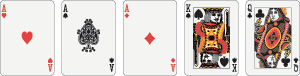
A hand that contains three cards of the same rank, plus two cards which are not of this rank nor the same as each other.
Two pairs
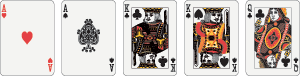
A hand that contains two cards of the same rank, plus two cards of another rank (that match each other but not the first pair), plus any other card (e.g. two 8s and two 7s, plus any other card). The hand with the highest pair takes precedence. If two players have the same top pair, the second pair of each hand is compared and determines the outcome. For example, Q-Q-10-10 is ranked higher than Q-Q-7-7.
Pair
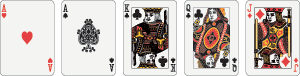
A hand that contains two cards of one rank, plus three cards which are not of this rank nor the same as each other. When comparing two hands with the same pair, the non-paired cards are compared in descending order to determine the outcome.
High Card
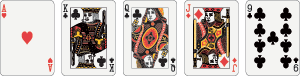
Five cards not meeting any of the above requirements. The hand with the highest-ranking card (A, K, Q being the highest and 4, 3, 2 being the lowest) is ranked higher. When comparing two hands with the same highest-ranking card, the next highest-ranking card from each hand is compared, and so on until a difference is found.
Omaha
Omaha is similar, using five shared cards. Each person receives four personal cards. To form the best combination of five cards, exactly two personal cards and three shared cards must be used.
All other procedures are the same as in Texas Hold’em. However, the contributions follow a limit equal to the total amount already placed in the round.